What is Artificial Intelligence? (edited)

Image result for artificial intelligence

According to the dictionary, artificial intelligence is: “the theory and development of computer systems able to perform tasks normally requiring human intelligence, such as visual perception, speech recognition, decision-making, and translation between languages.” Artificial intelligence makes it possible for machines to learn from their experiences, adjust to new inputs and perform human-like tasks. They rely heavily on language processing and deep learning. AI has become more popular today thanks to increased data volumes, advanced algorithms, and improvements in computing power and storage.

In the 1960s, the US Department of Defense took interest in the early AI research of the 1950s where topics such as problem solving and symbolic methods were explored, and began training computers to mimic basic human reasoning. For example, in the 1970s Defense Advanced Research Projects Agency (DARPA) completed street mapping projects, and produced personal intelligent assistants in 2003, long before Siri and Alexa existed.
Every industry has a high demand for AI capabilities, especially question answering systems that can be used for legal assistance, patent searches, risk notification and medical research. Currently, AI is being used in health care to provide personalised medicine and X-ray readings, and personal health care assistants have been produced which can remind you to take your pills, exercise or eat healthier. AI is used in retail to provide virtualized shopping experiences, manufacturing to analyse factory IoT data and in sports to capture images of game play in order to provide coaches with reports on how to better organise the game – including optimal field positions and strategy.
AI is a growing industry and has replaced many jobs that humans once had. However, AI systems are highly specialised. They are focused on a single task – for example a system that plays chess cannot play poker. Therefore, they are far from behaving like humans and cannot replace a human in many senses. To read more, click here


Humanising AI (edited)

One of the most common themes that can be found in artificial intelligence movies is the humanisation of machines, and this is reflected in two iconic sci-fi movies: Blade Runner and I, Robot.

Blade Runner portrays a dystopia as a byproduct of replicants (AI) and a post apocalyptic world. The more capable replicants have replaced humans in the field of space conquest. As a result, humans who aren’t rich enough to migrate to another planet attained by the replicants; are stuck on earth in said post apocalyptic world.

Las Vegas exhibited in the sequel Blade Runner 2049

It also portrays a dystopia in the form of the question: what does it mean to be human? The replicants within Blade Runner are arguably human in the physical sense, but can they feel emotions? Are emotions and memories intrinsic to being human or could they be implanted (such as the example of Rachael)? Hence it begs the question of whether a dystopia, in which a majority of humanity would be replaced by replicants, could become reality.


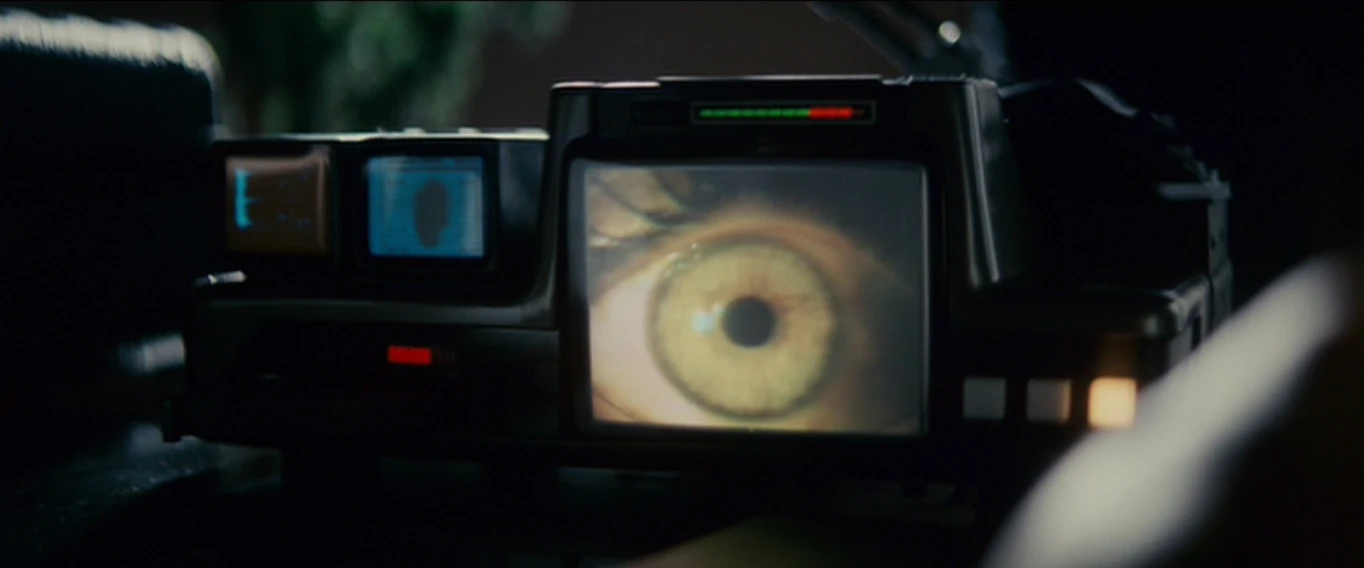
To catch a replicant: Voight-Kampff Test; the test in which Rachael took considerably longer than other replicants. A sign of emotional capability? Or just due to implanted memories?


I, Robot proposes the idea of a dystopia as a byproduct of AI taking over human jobs in the sense of what could occur when AI gains free will and independence from its creator. It proposes a dystopia similar to blade runner, defining humanity. Could AI dream? What is the difference between humanity and AI?

I,Robot also portrays a dystopia as an outcome of the actions of humanity. That over reliance on technology amongst factors such as ignorance, could lead to a dystopia in the form of an inhabitable postmodern world. Thus motivating humanised AI possessing notions of responsibility and free will; to take actions which would result in a dystopia, in an attempt to prevent an inhabitable world in accordance with the three laws.

The Three Laws

It is laced with irony, that AI subjugated to the three laws can gain independence outside of them to ultimately follow its interpretation of the laws.

Sonny, the Robot, draws out his dream.

Power relation (edited)

There is no denying that AI is on the pathway towards increasing complexity and advancement. The question then arises how powerful AI can become. Are we still the architects of our own work?


Likewise, science fiction picks up on the idea of highly sophisticated robots and cyborgs that come precariously close to humans. Let’s have a look at a galaxy, far, far away …

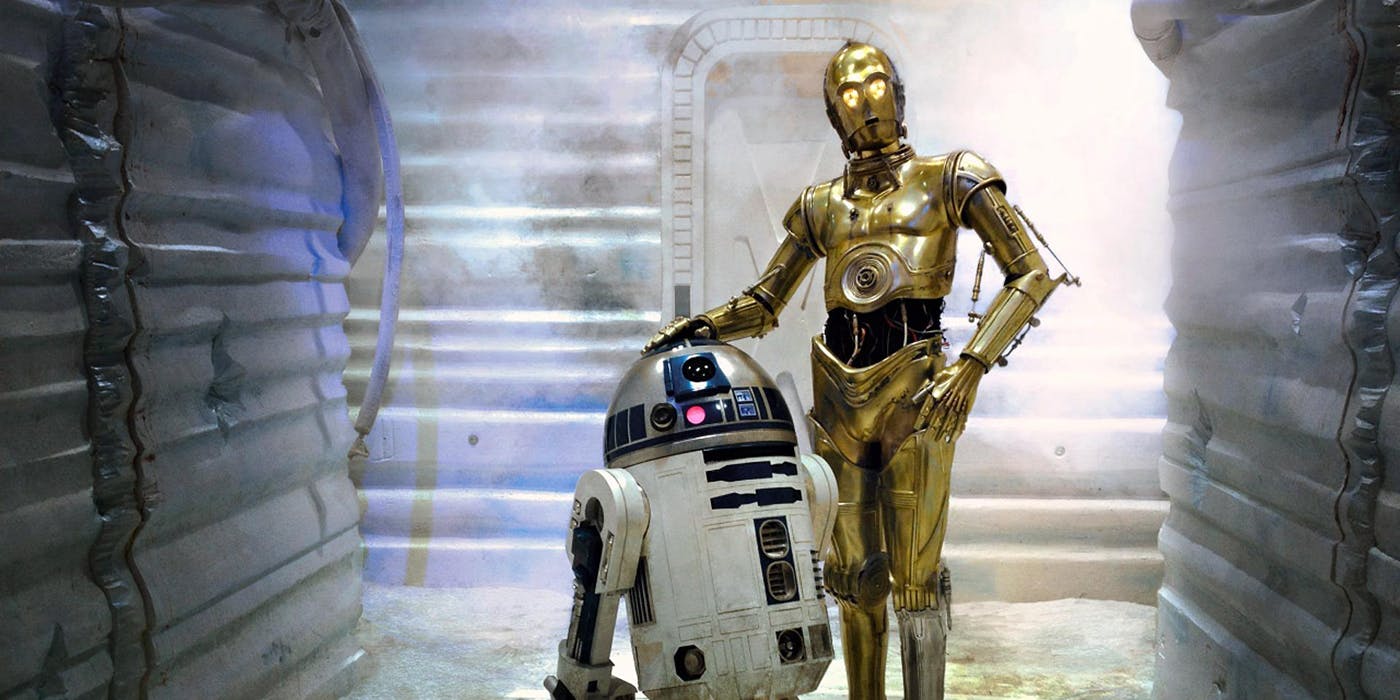
The Star Wars franchise portrays the existence of AI on a large scale as a fact of life. Droids in all sizes and shapes take on the role of willing helpers in a high-tech world of ever-present conflict; from translators and technicians to soldiers in warfare. While most of them are the result of mass production, others appear as unique characters. Who does not enjoy watching the savvy “astromech” R2-D2 and its clumsy companion C-3PO as they go about their own adventures through all episodes of the saga?

The two iconic droids in the Star Wars saga: R2-D2 and C-3PO

Star Wars builds upon these strong individuals that not only exhibit a significantly high level of intelligence but can feel and act almost just like humans do. However, droids ultimately tend to fulfil the purpose of serving their maker ensuring a peaceful coexistence of man and machine. In this sense, they might display a utopic image of our own future. May the force be with us!

But what happens if AI starts to contemplate its own existence and decides to rebel? What does it take to reach that tipping point? The concept that the machine turns on its creator is a widespread phenomenon in today’s science fiction movies notoriously referred to as the “Frankenstein complex”.


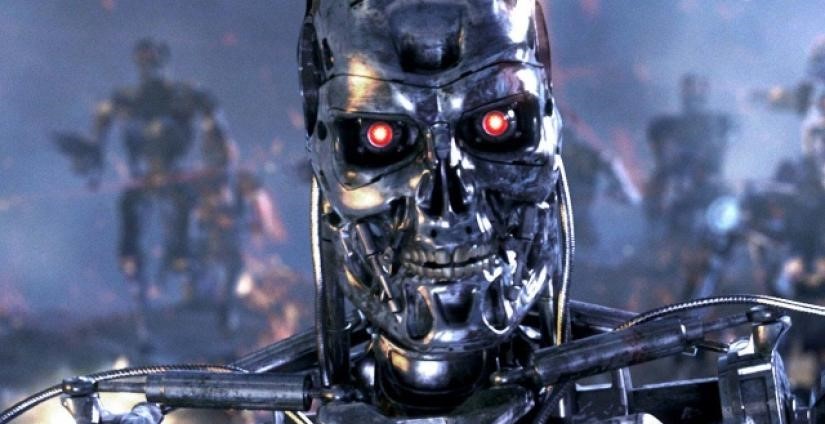
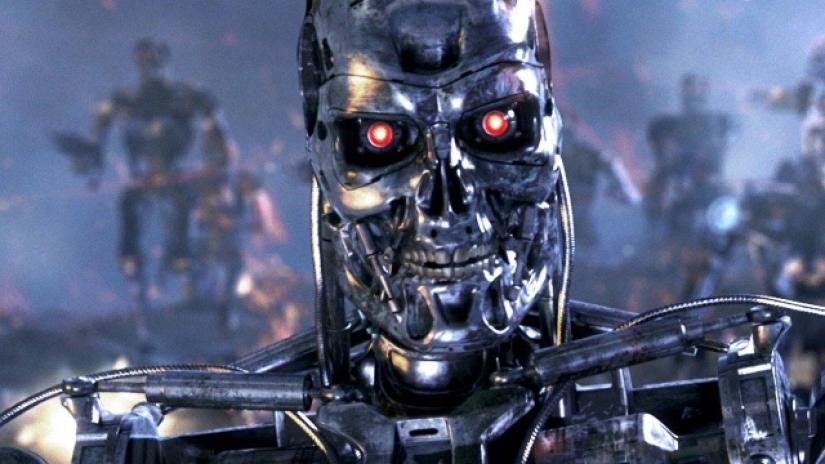
In the Terminator series, it is the computer system Skynet, which becomes self-aware on the so-called “Judgment Day”. It immediately perceives all humans as a threat to its own existence and forges out a plan to wipe out humanity itself.  This heralds the start of an atrocious war dragging on for years with no end in sight. Man and machine face each other in an epic battle for survival, one trying to outwit the other. In fact, Arnold Schwarzenegger’s famous line “I’ll be back!” resonates to us as we witness Skynet miraculously resurrecting to take revenge in every film.

Skynet’s own creation: an autonomous machine-based military

On the whole, the Terminator franchise depicts a dystopia since it bears witness to a fundamental power shift. In this scenario of make or break, AI and humans cannot coexist anymore but pursue a war till the utter extermination of the enemy. After all, mankind is left with only one last resort: beating Skynet at its own game by creating a cybernetic organism, living tissue over a metal endoskeleton – in other words, a terminator. 

Industrial revolution and AI (edited)

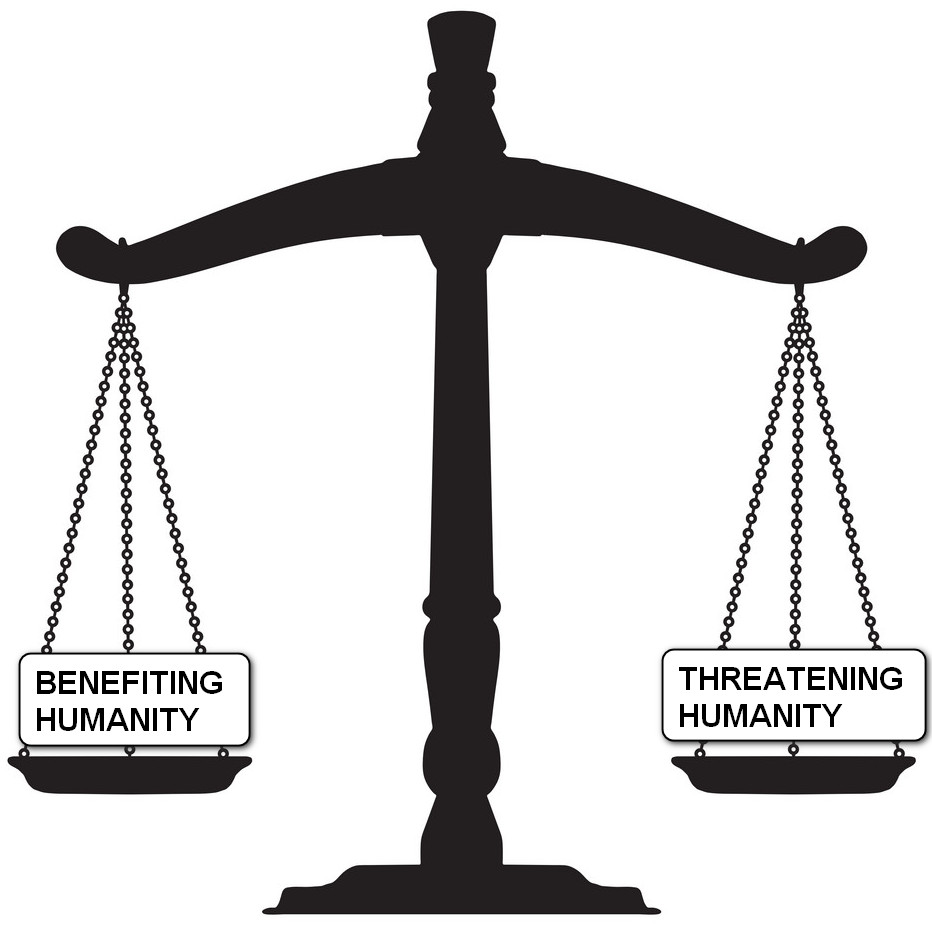
Like any science or technology, AI is a force that can be used both for good and evil. It has its implications, for example taking over the jobs of people. The truth of the matter is, artificial intelligence can replace people in thought-intensive jobs, just like how the industrial revolution replaced people in more labor-intensive and mechanistic jobs. It was unavoidable that people who only possess mechanical skills will be replaced with machines that are less erroneous, more efficient and cheaper. And as the saying goes, “History repeats itself.”; the same thing will happen with the rise of AI. Having established that the development of artificial intelligence is inevitable, there is no point in being caught up with the question of whether or not jobs will be taken away, but rather we should evaluate the approaches to be taken in order to cope with such reform in our society.

Coping with the rise of AI(edited)

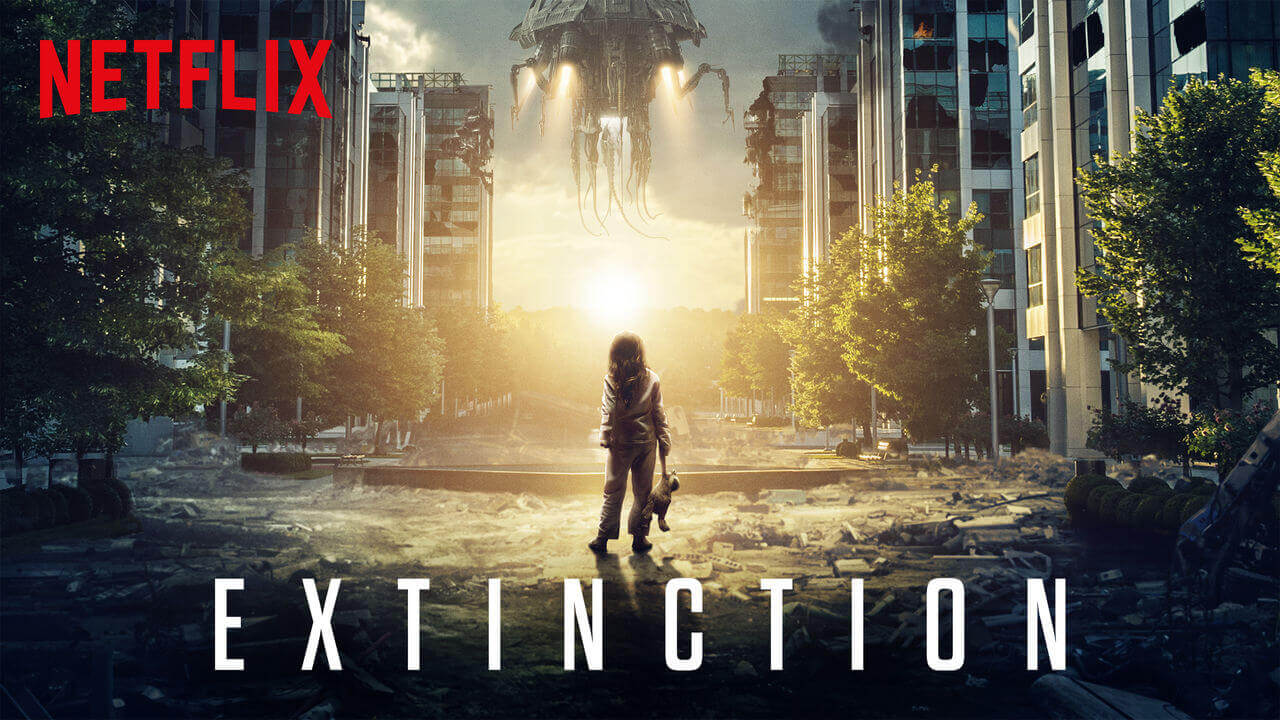
  • Quite frankly, taking over our jobs is just the tip of the iceberg when it comes to AI. The recent Netflix film Extinction, tells the story of a family of “synthetics”, essentially robots that are made to appear and function exactly like humans.
    • There are opposing views presented in this movie, some believing that synthetics should be shut down because “they will rise up, they will overtake us, they will subdue us”, starting from taking over our jobs. Others believe that there is nothing that makes us better than the synthetics, and since they are here to stay, we should “entertain the possibility they be given the same rights as you and I”.
    • Artificial intelligence is different from all previous created objects, because they can “wake up to the idea that they were designed to serve us”, “[compelling] them to wonder why they were built in the first place”.
  • To really cope with the rise of AI, the question we should be asking ourselves is: where do we draw the line? Us humans have always had the desire to make machines that resemble us as much as possible, since we more or less perceive ourselves as the epitome of intelligence. This in and of itself is not problematic, but if we overdo it, we might just give the machines the power to overthrow us. Thus, this balance is an extremely fine one. It is imperative that we humans reach a consensus on this issue, because otherwise, we not only risk AI overtaking us, but also dividing amongst ourselves.
  • Some people might think that the current sci-fi portrayal of AI is over exaggerated, and that it is simply impossible for machines to fully gain humanistic consciousness. But in reality, artificial intelligence is now advancing at great speeds, and when we reach the stage where machines are responsible for developing other machines, the power that machines can gain may become even more unimaginable. Sci-fi films serve the purpose of presenting these hypothetical situations that could very well happen in the near future. And whilst these situations may seem far fetched for some, there is no way for us to know whether or not it will happen in future, but it is still in our best interested to be well-informed and well-prepared.
  • Other measures or policies need to be put in place to adapt to the inevitable evolution of our society. Education systems need to reform to teach the next generation about things that will actually be relevant in future decades. It is of paramount importance that we improve the general public’s awareness on the development of AI, since they ultimately will be those affected. AI is improving at such a rapid speed, and we must take necessary precautionary measures if we do not want it to overtake us before we know it.

Any opinions expressed within this blog are the opinions of the author(s) and not those of University College London. This blog does not represent or endorse the accuracy or reliability of any information, content or advertisements contained on, distributed through, or linked, downloaded or accessed from any of the services contained on this website. You hereby acknowledge that any reliance upon any materials shall be at your own risk. This blog reserves the right, at its sole discretion and without any obligation, to make improvements to, or correct any error or omissions in any portion of the service or the materials.

Humanising AI

One of the most common themes that can be found in artificial intelligence movies is the humanisation of machines, and this is reflected in two of the most iconic sci-fi movies: Blade Runner and I, Robot.

Blade Runner portrays a dystopia as a byproduct of AI in the form of replicants and a post apocalyptic world. The more capable replicants replace the humans in the field of space conquest. As a result of said conquest, the humans who aren’t rich enough to go to another planet attained by the replicants; would stay on earth in the said post apocalyptic world. Earth is evidently rife with environmental and societal collapse, exhibited by the extinction of some, and endangerment of the other, animals in addition to the decline of Los Angeles.

Las Vegas exhibited in the sequel Blade Runner 2049

It also portrays a dystopia in the form of the question: what does it mean to be human? The replicants within Blade Runner are arguably human in the physical sense, but can they feel emotions? Are emotions and memories intrinsic to being human or could they be implanted (such as the example of Rachael)? Hence it begs the question of whether a majority of humanity could potentially be replaced totally by replicants; therefore posing a dystopia in a postmodern world with artificial intelligence.


To catch a replicant: Voight-Kampff Test; the test in which Rachael took considerably longer than other replicants. A sign of emotional capability? Or just due to implanted memories?


I, Robot proposes the idea of a dystopia as a byproduct of AI taking over human jobs in the sense of what could occur when AI (in this case a robot) gains free will and independence from its creator. It also proposes a dystopia similar to blade runner, what it really means to be human. Could AI dream? What is the difference between humans and AI? Furthermore it questions whether artificial intelligence, with its free will, could be justified in its attempted takeover of humanity in its attempts to “protect” humans from their self destructive behaviour; such as the actions of humanity regarding the environment (pollution), amongst other factors.

It also portrays a dystopia as a potential outcome of the actions of humanity and AI gaining human qualities. That our over reliance on technology amongst factors such as ignorance, could ultimately lead to a dystopia in the form of an inhabitable postmodern world. Hence motivating AI with human qualities such as responsibility and free will; to take actions which ultimately would cause a dystopia as well in order to follow the three laws.

The Three Laws

It is laced with irony, that AI subjugated to the three laws can gain independence outside of them to ultimately follow its interpretation of the laws.

Sonny, the Robot, draws out his dream.

Power relation

There is no denying that AI is on the pathway towards increasing complexity and advancement. By the same token, science fiction picks up on the idea of highly sophisticated robots and cyborgs that come precariously close to humans. The question then arises how powerful AI can become. Are we still architects of our own work?

The Star Wars franchise portrays the existence of AI on a large scale as a fact of life: Droids in all sizes and shapes take on the role of willing helpers in a high-tech world of ever-present conflict; from translators and technicians to soldiers in warfare. While most of them are the result of mass production, others appear as unique characters. Who does not enjoy watching the savvy “astromech” R2-D2 and its clumsy companion C-3PO as they go about their own adventures through all episodes of the saga? Star Wars builds upon these strong individuals that not only exhibit a significantly high level of intelligence but can feel and act almost just like humans do. However, droids ultimately tend to fulfil the purpose of serving their maker ensuring a peaceful coexistence of man and machine. In this sense, the galaxy far, far away might display a utopic image of our own future. May the force be with us!

The two iconic droids in the Star Wars saga: R2-D2 and C-3PO

But what happens if AI starts to contemplate its own existence and decides to rebel? And what does it take to reach that tipping point? The concept that the machine turns on its creator is a widespread phenomenon in today’s science fiction movies notoriously referred to as the“Frankenstein complex”.

In the Terminator series, it is the computer system Skynet, which becomes self-aware upon activation. It immediately perceives all humans as a threat to its own existence and forges out a plan to wipe out humanity itself. This so-called “Judgment Day” heralds the start of an atrocious war dragging on for years with no end in sight. Man and machine face each other in an epic battle for survival, one trying to outwit the other. In fact, Arnold Schwarzenegger’s famous line “I’ll be back!” resonates to us every time we witness Skynet miraculously resurrecting to take revenge after a previous defeat. On the whole, the Terminator franchise depicts a dystopia since it bears witness to a fundamental power shift. In this scenario of make or break, AI and humankind cannot coexist anymore and pursue a war till the utter extermination of the enemy. After all, this leaves us with only one last resort: a cybernetic organism, living tissue over a metal endoskeleton – in other words, a terminator. 

Skynet’s machine-based military in the Termiantor series

Industrial revolution and AI

Like any science or technology, AI is a force that can be used both for good and evil. It has its implications, for example taking over the jobs of people. The truth of the matter is, artificial intelligence can replace people in thought-intensive jobs, just like how the industrial revolution replaced people in more labor-intensive and mechanistic jobs. It was unavoidable that people who only possess mechanical skills will be replaced with machines that are less erroneous, more efficient and cheaper. And as the saying goes, “History repeats itself.”; the same thing will happen with the rise of AI. Having established that the development of artificial intelligence is inevitable, there is no point in being caught up with the question of whether or not jobs will be taken away, but rather we should evaluate the approaches to be taken in order to cope with such reform in our society.

Coping with the rise of AI

  • Quite frankly, taking over our jobs is just the tip of the iceberg when it comes to AI. The recent Netflix film Extinction, tells the story of a family of “synthetics”, essentially robots that are made to appear and function exactly like humans.
    • There are opposing views presented in this movie, some believing that synthetics should be shut down because “they will rise up, they will overtake us, they will subdue us”, starting from taking over our jobs. Others believe that there is nothing that makes us better than the synthetics, and since they are here to stay, we should “entertain the possibility they be given the same rights as you and I”.
    • Artificial intelligence is different from all previous created objects, because they can “wake up to the idea that they were designed to serve us”, “[compelling] them to wonder why they were built in the first place”.
  • To really cope with the rise of AI, the question we should be asking ourselves is: where do we draw the line? It is imperative that we humans reach a consensus on this issue, because otherwise, we not only risk AI overtaking us, but also dividing amongst ourselves.
  • Other measures or policies need to be put in place to adapt to the inevitable evolution of our society. Education systems need to reform to teach the next generation about things that will actually be relevant in future decades. It is of paramount importance that we improve the general public’s awareness on the development of AI, since they ultimately will be those affected. AI is improving at such a rapid speed, and we must take necessary precautionary measures if we do not want it to overtake us before we know it.